Writing / Building with AI
I’m Building an Army of Marketing Agents. Meet the First 7.
Every marketing decision should come from the last round of data. What worked, what didn’t, and what to do next.
Most teams already have the data. It’s just scattered. Leads live in the CRM. Ad results live in Meta. Traffic lives in GA4. Search lives in Search Console. Email lives somewhere else. By the time someone pulls it all together, the next decision has already been made.
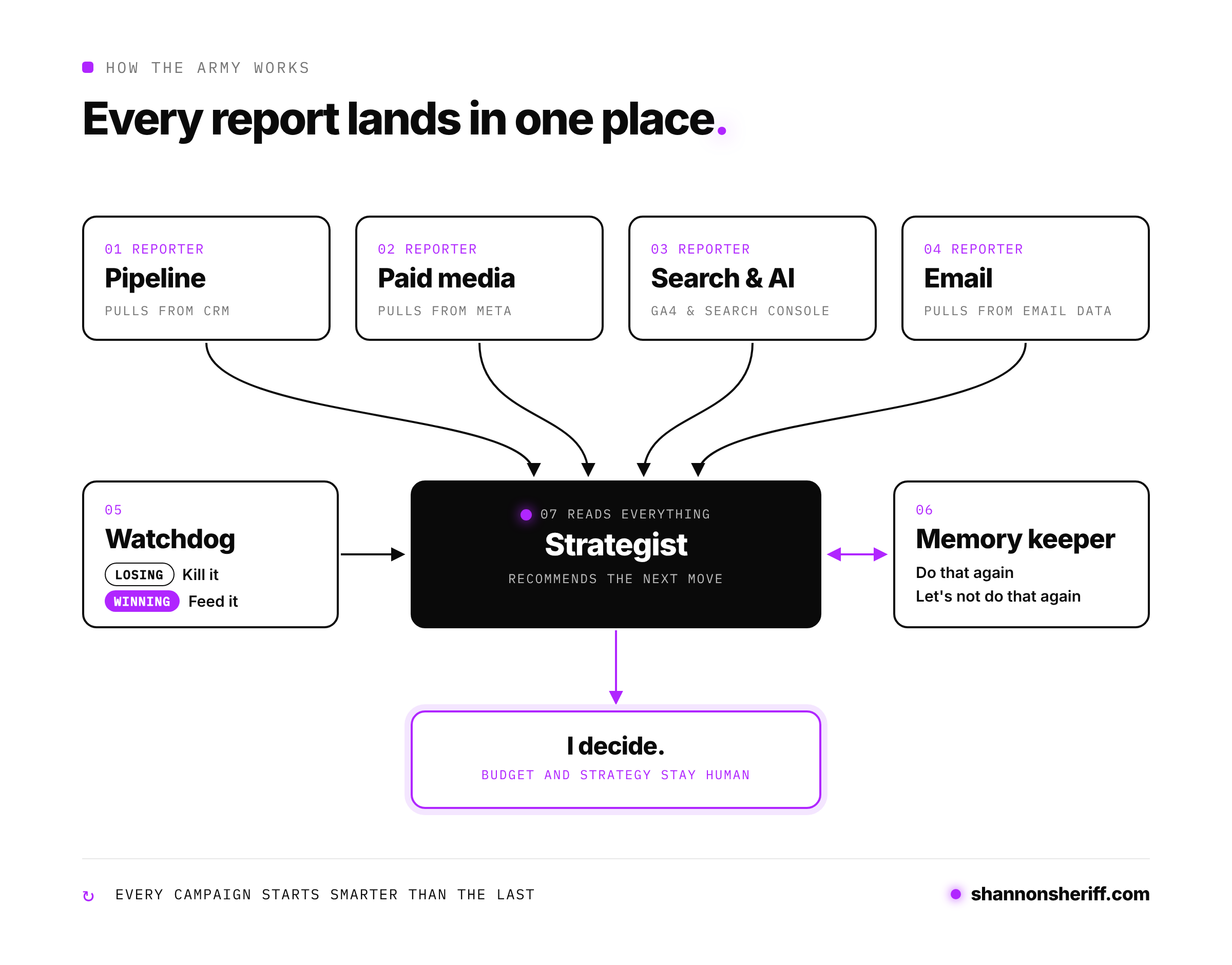
So I’m building a team of AI agents to fix that. My agents don’t replace those tools, and they don’t track anything new. They pull the reports from every source and build one complete picture. One agent receives all of it. And everything we learn goes into a memory, so every campaign starts smarter than the last.
I’m starting on 15 to 20 websites at once, so the agents will have real data to compare across sites, not one site’s guesswork.
I’ve already built and run reporting agents one at a time. They work. The next step is getting them to work together: sharing data, feeding one strategist, and building a memory over time. Here is the team.
Agent 1: The pipeline reporter
Pulls lead data from the CRM and reports:
- Total, accepted, and non accepted leads
- Acceptance rates
- Accepted and lost leads by channel
- Pace to goal
Agent 2: The paid media reporter
A platform can report cheap leads all day without telling you whether any of them became real opportunities. This agent pulls the ad data and lines it up against what actually happened.
It reports:
- Paid versus organic Meta leads, separated at the source
- Spend and cost per lead by campaign
- In app lead forms versus website conversions
- Cost per accepted lead, the number that actually matters
- Spend against plan across every channel
Agent 3: The search and AI visibility reporter
Search is changing fast, so this agent pulls both the old scoreboard and the new one.
From GA4 and Search Console, it reports:
- Organic traffic and engagement
- Year over year comparisons
- Keyword movement and performance by page type
- Clicks, impressions, click through rate, and position
- AI referrals, using custom GA4 channels built to catch visits from ChatGPT, Gemini, Perplexity, and other AI tools
Being mentioned by AI isn’t the goal. The goal is for AI to recommend us over everyone else. With 15 to 20 sites in the mix, this agent can show which pages and which sites AI actually sends people to, and which ones it ignores.
Agent 4: The email reporter
Say we send 15 emails and three of them crush it. I don’t just want to know which three. I want to know why, so we can do it again.
I’ve already pulled the data for thousands of emails, so this agent has plenty to learn from. It reports:
- Open, click, and conversion results for every send
- Subject line and preview text patterns, judged as a pair
- Content and offer patterns
- Comparisons between similar campaigns and audiences, so it isn’t comparing apples to oranges
Winners become the next round of tests. Losers go somewhere else. More on that in Agent 6.
Agent 5: The watchdog
The watchdog watches performance across every campaign and every site, with one question in mind: is this bringing in accepted leads, or just leads?
- If something is underperforming, we kill it. Spend with no accepted leads coming back gets flagged fast.
- If something is exceeding, we feed it. Winners get flagged so they can get more budget while they’re hot.
The watchdog flags. People decide. Small samples and conversion delays can make a short stretch look better or worse than it really is.
Agent 6: The memory keeper
This is the agent most teams don’t have, and it might be the most valuable one.
Every result lands in one of two lists:
- Do that again. The subject lines, offers, audiences, and channels that worked, with the numbers that prove it.
- Let’s not do that again. The lowest performers, and why they missed.
Marketing teams forget. People leave, campaigns blur together, and the same bad idea gets tried again two years later. The memory keeper makes sure that doesn’t happen.
Agent 7: The strategist
Every report from every agent goes to one place.
The strategist reads all of it together: the pipeline, the ad spend, search, AI referrals, email, the watchdog’s flags, and the memory. Then it recommends what to do next. Shift budget here. Test this subject line style. Kill that campaign type.
The strategist recommends. I decide.
The number I’m watching
Cost per lead. And more importantly, cost per accepted lead.
If this works, those numbers should go down. Better data, faster decisions, less money spent on things that already failed once. I’ll be tracking exactly how far the agents can push them.
The agentic workflow, start to finish
Here is how one cycle runs, from raw data to the next campaign.
- Pull. The reporters pull fresh data from the CRM, Meta, GA4 with its custom AI referral channels, Search Console, and the email platform.
- Report. Each reporter builds its piece: the lead pipeline, cost per accepted lead, search and AI referrals, and email patterns.
- Watch. The watchdog scans every campaign and every site. Losers get flagged to kill. Winners get flagged to feed.
- Remember. The memory keeper files every result under “do that again” or “let’s not do that again.”
- Recommend. The strategist reads all of it at once and recommends the next move.
- Decide. I make the call.
Then the cycle starts over, and every campaign starts smarter than the last.
The rules for the army
Agents don’t fix unclear thinking. They scale it. So before any of this runs:
- Every metric gets defined. What counts as a lead, what counts as accepted, which records are tests, what gets excluded. Automating a fuzzy calculation just repeats the same confusion faster.
- The math is fixed and traceable. Every number leads back to its source.
- Agents report. They don’t invent. No made up numbers, and no confident explanations for every little dip.
What comes next
The reporters are proven on their own. Now the work is connecting them. Each one has to hand off clean, consistent numbers before the strategist can trust them, so every report gets checked against numbers we already trust before it joins the system.
Then the strategist and the memory keeper come online, and the real test begins: does cost per accepted lead go down?
Less time building reports. More time acting on them.
I’ll share what works, what breaks, and what happens to our cost per lead as the army comes together.
Questions about this post
What is an agentic marketing workflow?
An agentic marketing workflow uses AI agents to run the reporting cycle. In this setup the cycle has six steps: pull fresh data, report on each channel, watch for winners and losers, remember what worked, recommend the next move, and then a person decides.
What does a marketing reporting agent do?
A reporting agent pulls data from a source such as a CRM, Meta ads, GA4, Search Console, or an email platform and turns it into a consistent report. It does not replace the tool or invent numbers. Every number traces back to its source.
What is cost per accepted lead?
Cost per accepted lead is ad spend divided by the leads that were accepted as real opportunities, not every form fill. A platform can report cheap leads that never turn into anything, so cost per accepted lead shows what a campaign actually delivered.
How do you track AI referrals in GA4?
Set up custom channel groups in GA4 that catch visits coming from ChatGPT, Gemini, Perplexity, and other AI tools. That separates AI referrals from regular referral traffic so you can see which pages and sites AI actually sends people to.
Should AI agents make marketing decisions?
Not on their own. In this system the watchdog flags campaigns and the strategist recommends, but a person makes the call. Small samples and conversion delays can make a short stretch look better or worse than it really is.